It started with India.
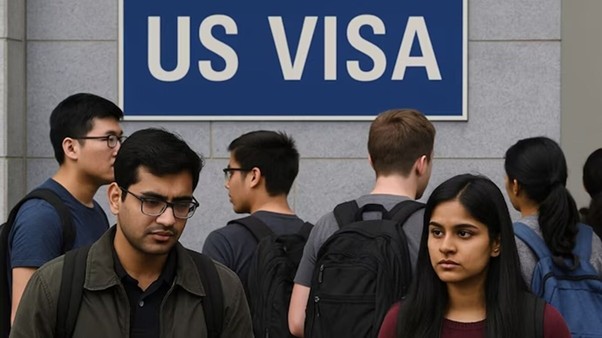
In September, student forums lit up with panic when visa queues stretched past the start of semester. Some waited four months just for an interview slot. Others cancelled flights, housing, dreams.
“I’ve done everything right,” one student wrote in frustration on a Chennai WhatsApp group. “Now my future depends on an appointment date.”
Across the ocean, another kind of anxiety brewed. Washington had just rolled out a new $100,000 H1B fee and tightened entry rules. Headlines screamed. Parents worried. Recruiters scrambled.
Meanwhile, in Chengdu, 22-year-old Chen watched the U.S. visa portal crash the day she applied. “It doesn’t feel like something that should happen these days,” she said.
From Mumbai to Manila to Hanoi, Asia’s brightest students are watching the American dream turn bureaucratic. The U.S. visa system, once the world’s fast lane for talent, now feels like a traffic jam.
For years the U.S. higher education and employer ecosystem counted on Indian students to fill vital roles: study, train, work, repeat. But in August 2025, the rhythm broke. Student arrivals from India dropped about 45% from the previous year, a clear sign that the once-steady pipeline is starting to crack.
For universities and employers this means the once-steady “India funnel” is no longer guaranteed. For Indian students the stakes feel personal: a family investment, the dream of moving abroad, now clouded by policy shifts.
Our view: this is the moment when the U.S. can either reaffirm its openness or cede ground to alternatives, and for institutions the time to hedge is now.
f India’s story is about volume-pipeline risk, China’s is about strategic disruption.
In May 2025 the U.S. announced plans to “aggressively” revoke visas for Chinese students, especially those studying in critical fields or with links to the Chinese Communist Party.
Back in Chengdu, Chen, the same student who watched the visa portal crash in September, said, “It’s pretty absurd. It doesn’t seem like something that should happen these days. If I really can’t go to the U.S., I may take up an offer from the UK’s LSE.”
Another postgraduate student, Lainey (24, Beijing) waiting for her PhD visa: “We feel helpless and unable to do anything … From applying for my PhD until now, this series of visa policies is not very favourable to us.”
Beyond India and China lies a cluster of emerging student markets: Vietnam, Bangladesh, Nepal, Malaysia, Sri Lanka. They’re less high-profile but vulnerable.
For these students, the visa-interview backlog and increased scrutiny matter. The changes don’t target them specifically, yet the squeeze is real.
One recent article noted that international student arrivals from Asia fell roughly 24 % in August 2025.
Connectivity, deferment, cost-risk – those apply here too. Also, these markets are often the “next rung up” for institutions and employers if India/China options shrink. This means that competition for them will tighten.
Our view: institutions ignoring this region are leaving money and talent on the table.
Shifts like this force three strategic responses: diversify, adapt, communicate.
The “American dream” for students from Asia isn’t dead, but it’s no longer the default. Tougher, less predictable, and arguably less welcoming.
For marketers working across global education, talent-mobility and employer-branding this is a turning point. If you treat U.S. policy as a constant, you’ll be behind. This is the moment to adjust.
If your institution or employer brand serves Asian student/talent pipelines, you’ll want a sharper map of shifting visa dynamics, destination-competition, and recruitment/branding strategy.
Let’s talk. We can help you restructure your messaging, align your offer, and pivot before the next cycle.
Asian students still dream of studying in the United States, but the path has become steeper. India faces visa delays and policy confusion, China is dealing with targeted scrutiny, and the rest of Asia feels the ripple effect. As costs rise and wait times grow, more families are exploring other destinations. For universities and employers, the smart move now is to diversify, communicate clearly, and plan ahead.
Asian students are reconsidering studying in the United States because of visa delays, stricter immigration policies, higher costs, and uncertainty around work opportunities after graduation.
Indian students often face long visa interview wait times, policy uncertainty around H 1B work visas, and rising tuition costs that make the overall pathway less predictable.
Chinese students are experiencing increased visa scrutiny and revocations, which has made many families reconsider whether the United States is the most reliable study destination.
Countries such as Canada, the United Kingdom, Australia, and several Asian education hubs are attracting more students who are reconsidering the United States pathway.
Universities and employers that depend on international talent must diversify recruitment strategies and communicate clearly about visa policies, career pathways, and long term opportunities.