China platform strategy gets messy when every channel is asked to do the same job.
WeChat is told to create mass discovery.
Xiaohongshu is expected to close every sale.
Douyin is judged on whether people become long term CRM contacts.
Then, three months later, somebody announces that one of the platforms “doesn’t work.”
Usually the platform was not the problem. The job was.
WeChat, Xiaohongshu and Douyin have all become large, sophisticated ecosystems. Each can support content, advertising, search and some form of commerce. Their capabilities increasingly overlap. Their strengths do not. That distinction matters far more than which platform currently has the largest user number.
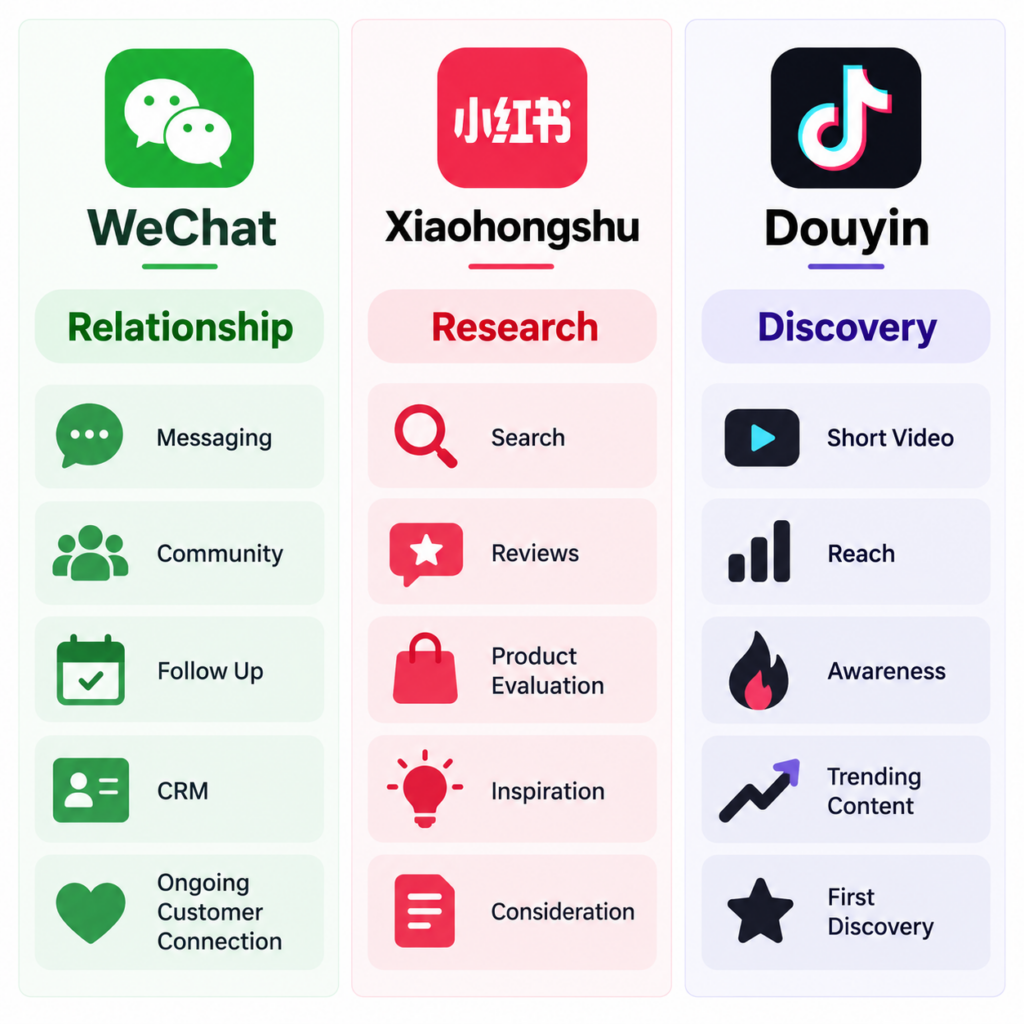
Brands should prioritize WeChat when they need an ongoing customer relationship, deeper content, customer service, WeCom, CRM integration, Mini Programs, private traffic or conversion support.
Prioritize Xiaohongshu, also known as Little Red Book, when customers need to discover, research, compare and build confidence through useful content, reviews and creators.
Prioritize Douyin when the objective is large scale short video discovery, entertainment led reach, live content or content driven commerce.
Most international brands eventually need more than one. The mistake is launching all of them simply because they exist.
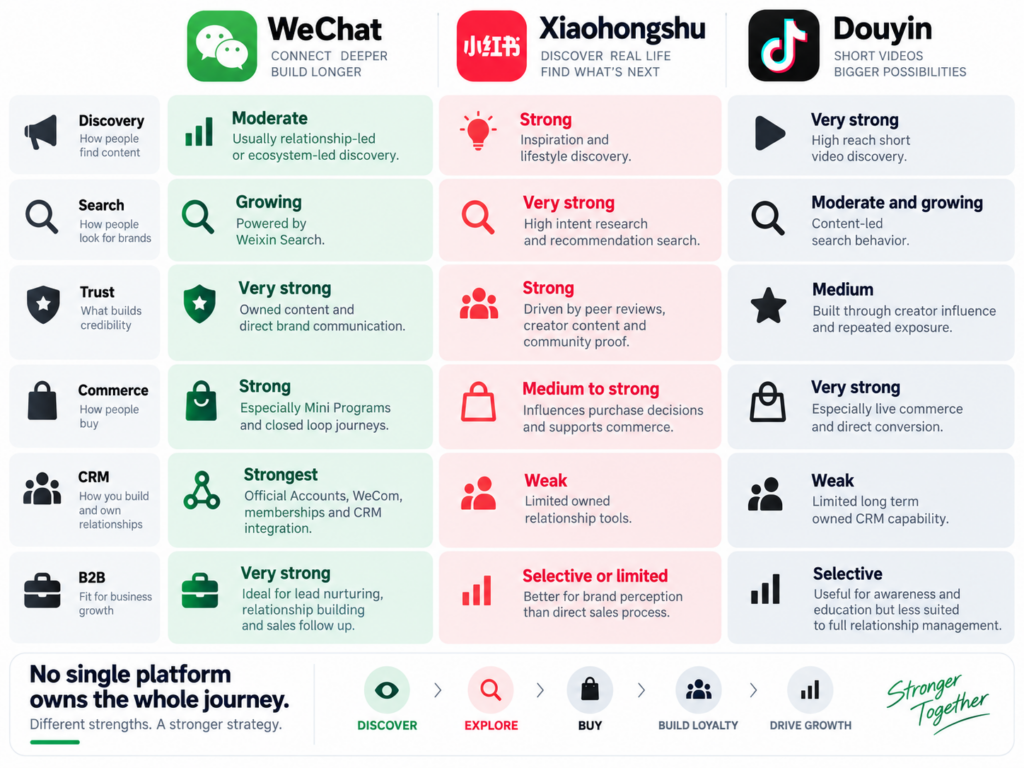
Area | Xiaohongshu | Douyin | |
Core strength | Relationship and customer journey | Discovery, search and consideration | Reach, video discovery and commerce |
Typical user behaviour | Follow, read, enquire, transact, return | Search, compare, save, review, research | Watch, discover, search, interact, buy |
Content strength | Articles, services, Mini Programs, Video Accounts | Searchable notes, reviews, guides, creators | Short video, livestreaming, creator content |
Strong for brand trust | Yes | Yes, especially peer style trust | Possible, but creative quality matters heavily |
Strong for broad discovery | Moderate and improving | Strong in relevant categories | Very strong |
Strong for search behaviour | Growing | Very strong | Increasingly important |
Strong for CRM and follow up | Very strong | Limited | Limited compared with WeChat |
Strong for ecommerce | Mini Programs and connected journeys | Growing commerce capability | Strong native commerce ecosystem |
B2B suitability | Very strong | Useful in selected categories | Selective |
Creative demand | Moderate | High | Very high |
Useful for private traffic | Very strong | Can support lead and private operations | Usually supporting rather than central |
Best question to ask | How do we continue the relationship? | What is the customer researching? | What will stop the scroll and create action? |
The table is deliberately not a winner board. A beauty brand and an industrial equipment company should not arrive at the same answer.
WeChat becomes more valuable after someone already has a reason to care.
That person may have discovered the brand through an exhibition, Xiaohongshu post, Douyin video, Baidu search, store visit or recommendation.
WeChat then gives the company somewhere to continue the relationship.
An Official Account can hold deeper brand and product information. WeCom can connect customers with employees. Mini Programs can support bookings, ecommerce, lead generation or service. Customer groups can support communities where there is a genuine reason for them to exist.
CRM can sit behind that relationship.
This is why WeChat tends to work particularly well for longer buying cycles, existing customers, membership, B2B, education, professional services and categories where people need more information before making a decision.
It would be outdated to describe WeChat purely as a place to manage existing followers.
Search, Video Accounts, Mini Programs and paid media have expanded discovery inside the ecosystem.
But discovery is still not where we would begin when explaining why a brand needs WeChat.
The platform’s real advantage is continuity.
A customer can move from content to service, conversation, booking, payment or membership without the brand having to rebuild the relationship from scratch every time.
That is difficult to replicate on a platform designed primarily around algorithmic content discovery.
WeChat should usually move toward the front of the plan when:
For an industrial manufacturer, a strong WeChat and WeCom system may be far more valuable than millions of short video views.
For a beauty brand launching an unfamiliar product, that order may be reversed.
Xiaohongshu is strongest when the customer is trying to decide.
What should I buy?
Where should I stay?
Which university is better?
Is this restaurant worth visiting?
Does this skincare product actually work?
What should I wear?
Where should I go in Shanghai?
That behaviour makes Xiaohongshu unusually valuable because discovery and evaluation often happen in the same environment.
Calling Xiaohongshu a lifestyle feed now understates what users do there.
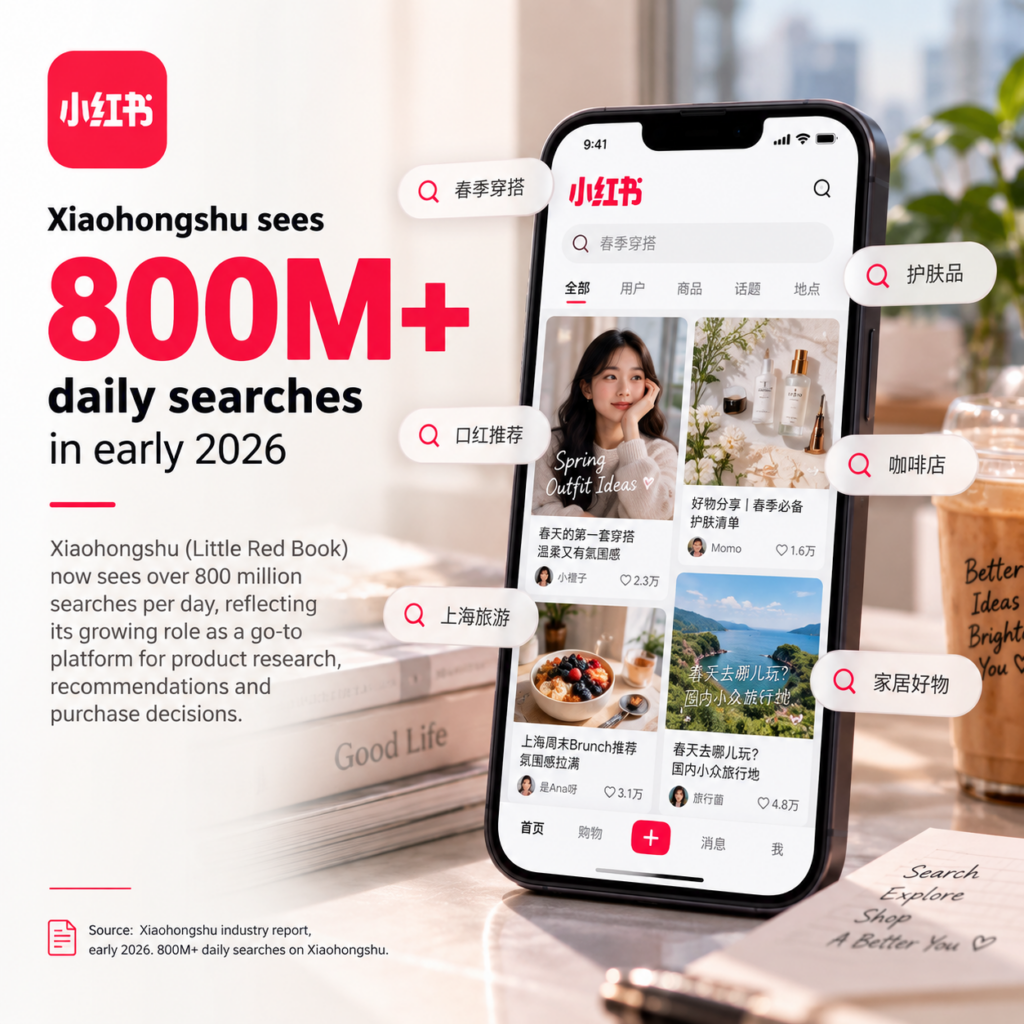
According to reporting on Xiaohongshu’s 2025 search trends, users conducted around 250 billion searches during 2025, with average daily searches exceeding 700 million. More recent reporting in September 2026 puts daily searches at more than 800 million in early 2026. These figures come from industry reporting rather than Xiaohongshu audited financial disclosures, but the direction is important: search has become central to the platform experience.
A user may see a beauty recommendation in the feed and then search the ingredient.
They may hear about a hotel elsewhere and search Xiaohongshu for real guest experiences.
They may save five restaurant posts before choosing one.
The content is therefore not finished when the first burst of reach disappears.
A useful note can continue influencing decisions through search.
The starting question should not be:
What should we post this week?
It should be:
What is the customer trying to figure out?
That leads to much stronger content.
A hotel should answer neighbourhood, room, transport and experience questions.
A beauty brand should address skin concerns, ingredients, usage and comparisons.
A university should show what student life actually feels like, not simply translate a prospectus.
Xiaohongshu’s own commercial platform now positions the ecosystem across brand building, product seeding and business conversion, including lead generation, private operations and offline conversion. The platform has moved well beyond simple awareness.
Xiaohongshu deserves early investment when:
It can also work outside those obvious categories, but the content still needs a reason to belong in the user’s research process.
Douyin is the strongest of the three when the brand needs to generate a lot of attention quickly through video.
Its strength comes from recommendation.
Someone does not need to follow the brand or search for the category before encountering the content.
A strong video can enter the feed because the platform believes the viewer will find it interesting.
That creates enormous potential for brands with products that can be demonstrated, transformed, tasted, worn, experienced or explained visually.
Douyin’s commercial ecosystem now stretches from short video and livestreams into search, stores and marketplace style shopping.
The official Douyin service terms describe video, livestreaming, publishing, interaction and search as platform services, while Douyin Ecommerce operates stores, marketplace commerce and creator driven selling.
That matters because the old journey:
Watch video → leave platform → search elsewhere → buy
is increasingly becoming:
Watch → investigate → buy
inside one ecosystem.
During the 2025 618 shopping festival, Douyin Mall reported marketplace GMV growth of roughly 77% year on year, while search driven GMV increased 56%. Shelf based commerce accounted for more than 45% of business during the campaign. Those are promotional period figures rather than normal annual growth rates, but they show how far Douyin has moved beyond livestreaming alone.
The opportunity is large.
So is the content requirement.
A company that publishes one repurposed corporate video a month is unlikely to learn much about Douyin.
The platform rewards brands that can test hooks, formats, presenters, creators, topics and offers quickly.
That means Douyin can be a poor first platform for an international brand with:
A huge audience does not solve those problems. It exposes them.
Douyin becomes particularly compelling when:
It can also play a strong brand role for automotive, tourism, education and even B2B businesses when there is genuinely interesting expertise to show.
Not every company needs to become an entertainment brand to use Douyin.
But every company does need something worth watching.
This is where the platform choice gets more interesting.
Xiaohongshu is adding more commerce.
Douyin is building search.
WeChat is expanding discovery.
Their boundaries are becoming less tidy.
QuestMobile’s 2026 618 analysis described content platforms as increasingly important for both product seeding and conversion, while traditional marketplace platforms remained stronger for purposeful purchasing. On June 18, 2026, it measured 712 million active users on Douyin and 127 million on Xiaohongshu during the shopping festival.
So it is no longer accurate to say:
Xiaohongshu is awareness.
Douyin is video.
WeChat is retention.
Those descriptions are useful starting points, not hard boundaries.
The real strategic difference is the dominant user behaviour on each platform.
Baidu solves a different problem.
Social platforms are excellent at creating and shaping demand.
Search becomes particularly useful once someone can describe what they need.
That distinction is important for B2B, education, healthcare, industrial products, professional services and high consideration purchases.
Someone searching:
industrial filtration supplier China
is behaving differently from someone watching a factory video on Douyin.
The search already contains intent.
Baidu reported 644 million Baidu App monthly active users in June 2026. The company is also rebuilding search around AI, with traditional search increasingly mixed with generated answers, agents and other AI experiences.
For international brands, Baidu can therefore sit alongside social media rather than compete with it.
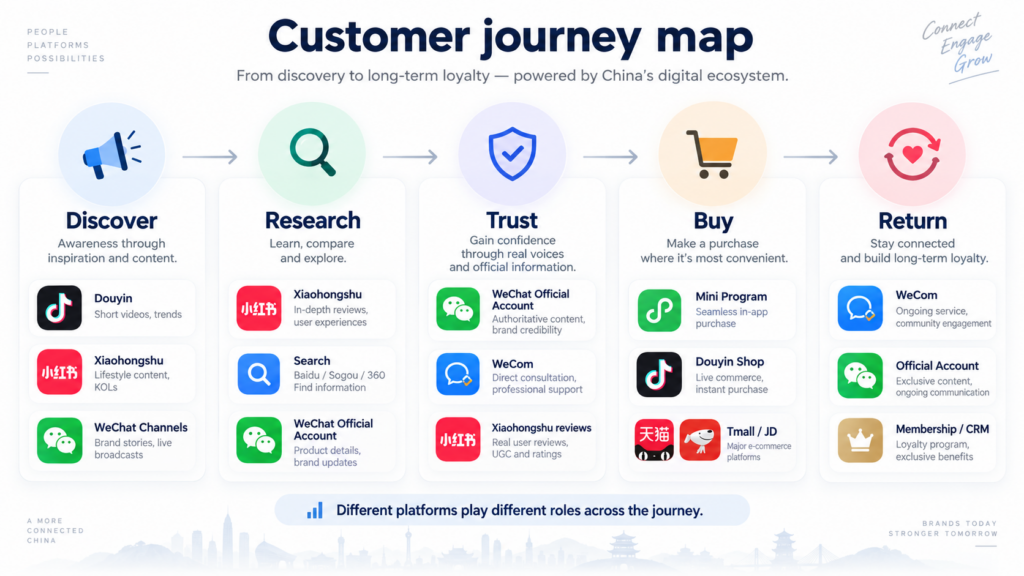
Xiaohongshu or Douyin may create curiosity. Baidu can capture explicit research. WeChat can continue the relationship.
Tmall is different again.
It is primarily about the transaction.
A customer may discover the product on Douyin, research it on Xiaohongshu, follow the brand through WeChat and ultimately buy through Tmall.
That is not a broken customer journey.
It is normal platform behaviour in China.
Brands sometimes become frustrated because Xiaohongshu engagement does not immediately become Xiaohongshu sales.
That misses how influence works.The platform that shapes the decision does not always receive the transaction.
For brands where ecommerce is the commercial objective, marketplace visibility, product pages, reviews, store operations, pricing and promotional strategy need to be considered alongside social content.
There is no universal sequence, but the following framework is a useful starting point.
Business type | Likely first priority | Supporting platforms | Why |
Beauty and skincare | Xiaohongshu | Douyin, Tmall, WeChat | Research, reviews and peer trust matter heavily |
Fashion and luxury | Xiaohongshu | WeChat, Douyin, Tmall | Discovery and aspiration need to connect with loyalty and purchase |
FMCG | Douyin or Xiaohongshu | Tmall, WeChat | Broad discovery, creator influence and commerce |
Tourism and hospitality | Xiaohongshu | Douyin, WeChat | Destination research, visual discovery and booking support |
Higher education | Xiaohongshu or WeChat | Baidu, Douyin | Student discovery needs deeper information and lead nurture |
B2B and industrial | WeChat and WeCom | Baidu, selective Douyin | Longer buying cycles and sales follow up matter more than mass reach |
Professional services | Baidu, Xiaohongshu where relevant | Trust, expertise and ongoing relationships | |
Retail with physical stores | Xiaohongshu | Douyin, WeChat | Local discovery can lead directly to store visits |
Ecommerce first consumer brand | Tmall or Douyin | Xiaohongshu, WeChat | Conversion infrastructure needs discovery and retention support |
This is a prioritization framework, not a rule.
A skincare company with strong Douyin creative may sensibly lead there. A luxury brand with an established customer database may place WeChat much higher. The platform should follow the commercial reality of the brand.
If the goal is simply broad exposure, Douyin usually has the strongest natural advantage because of its enormous video audience and recommendation system.
But awareness quality matters.
A niche beauty brand may get more useful awareness from Xiaohongshu because the audience is already researching the category.
A B2B software company may prefer far less reach on WeChat or Baidu if the people reached are actual buyers.
The biggest number is not automatically the best audience.
There is no clean answer because “conversion” can mean different things.
If conversion means an ecommerce transaction, Douyin and Tmall can provide strong native purchasing environments.
If conversion means a qualified lead, booking or sales conversation, WeChat, WeCom and Mini Programs may be more appropriate.
If conversion means persuading someone that a product is worth considering, Xiaohongshu may have already done much of the commercial work before the sale appears elsewhere.
This is why last click reporting can make a strong platform look weak.
The transaction is only the final visible action.
For most international B2B brands, I would start with WeChat and WeCom, supported by Baidu.
The reason is simple.
B2B buyers usually need evidence, technical information, people to speak with and time to make the decision.
WeChat is well suited to that process because content, customer communication and CRM connected follow up can work together.
Douyin can still create awareness.
Xiaohongshu can matter in architecture, design, technology, professional education, healthcare and other categories where peer experience or visual discovery influences decisions.
But I would not build a B2B plan around a consumer platform trend simply because everyone is talking about it.
Start where the biggest gap in the customer journey exists.
If nobody knows you:
Xiaohongshu or Douyin may need to come first.
If people know you but cannot properly research you:
Xiaohongshu, Baidu or a Chinese website may be more important.
If interest exists but leads disappear:
WeChat and WeCom deserve attention.
If people want to buy but the purchase experience is weak:
Tmall, Douyin ecommerce or a Mini Program may become the priority.
That is a much better way to make the decision than copying a competitor’s channel list.
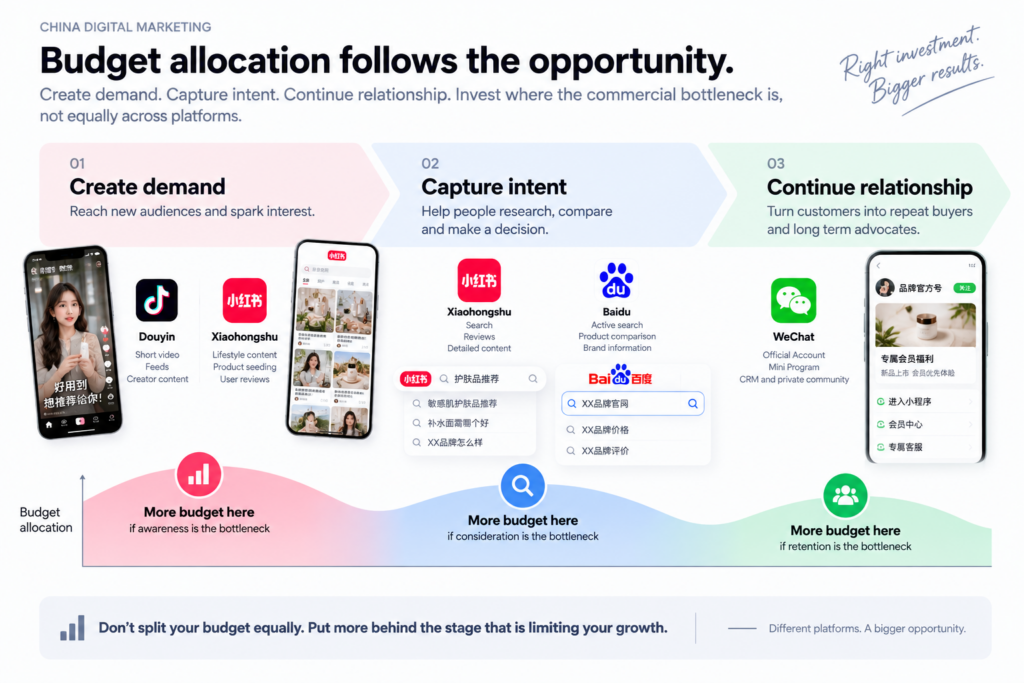
Do not start by giving every platform the same amount of money.
That often produces weak results everywhere.
The budget should reflect three things:
Where demand is created.
Where decisions are made.
Where value is captured.
For a new beauty brand, Xiaohongshu may receive most of the early content and creator investment because consideration is the bottleneck.
For an established consumer brand with high awareness but weak retention, WeChat membership, CRM and Mini Programs may deserve more.
For a brand built around video demonstrations and direct commerce, Douyin may take the largest share.
If a company has no China performance history at all, one practical approach is to place the clear majority of test investment behind the most important platform, keep a smaller supporting allocation for the second channel and reserve a limited amount for experimentation.
The exact percentages should come after the customer journey is understood.
Not before.
It looks ambitious.
Operationally, it can be a disaster.
Three platforms mean three content systems, three sets of platform rules, different creative requirements, different media products and different measurement questions.
Better approach: launch in sequence.
A WeChat article pasted into Xiaohongshu is not localization.
A Xiaohongshu image carousel turned into a Douyin slideshow is not necessarily a video strategy.
Each platform has a different reason people open it.
Better approach: keep the strategic idea consistent while rebuilding the execution for the platform.
China’s biggest platforms are all large enough to waste a lot of money. Audience relevance matters more.
Better approach: Start with customer behaviour
Xiaohongshu has visual content and creators, but search, saves, comments and long term discovery make the behaviour very different.
Better approach: build content people will research and return to.
Douyin has its own content culture, commerce infrastructure, search behaviour and advertising ecosystem.
Better approach: build specifically for Douyin.
Four articles a month do not automatically create a customer relationship.
Better approach: connect content to Official Accounts, WeCom, Mini Programs, service, CRM and useful next actions.
A buyer explicitly searching for a supplier, course, product or solution may be showing more intent than someone passively watching content.
Better approach: map search and social together.
A Douyin view, Xiaohongshu save and WeCom conversation are not equivalent actions.
Better approach: measure each channel according to the role it plays.
Brand objective | Best first platform | Supporting platform |
Build an ongoing customer relationship | Baidu, Xiaohongshu | |
Lifestyle discovery and research | Xiaohongshu | WeChat, Tmall |
Short video reach | Douyin | |
Ecommerce sales | Tmall or Douyin | Xiaohongshu, WeChat |
B2B lead nurturing | WeChat and WeCom | Baidu |
Local store discovery | Xiaohongshu | Douyin, WeChat |
High intent search | Baidu | |
Membership and retention | Commerce platforms |
We do not think brands should begin China planning by asking:
Which platforms should we be on?
That question often leads to a checklist mentality: open an account on every major platform, then work out what each one is supposed to do afterwards.
The better sequence is:
Who are we trying to reach?
What are they trying to decide?
Where does that behaviour already happen?
What should they be able to do next?
Only then should the platform mix be decided.
That may produce a surprisingly simple answer.
A B2B company might begin with Baidu, WeChat and WeCom.
A beauty brand could need Xiaohongshu, KOLs and Tmall before it needs a serious WeChat investment.
A tourism brand may need Xiaohongshu for trip planning, Douyin for inspiration and WeChat for service or booking support.
Different jobs. Different platforms.
Our own client work reflects this.
Digital Crew’s published case study material describes Longchamp using a combination of social and search activity to strengthen credibility and engagement with Chinese consumers, rather than relying on one channel.

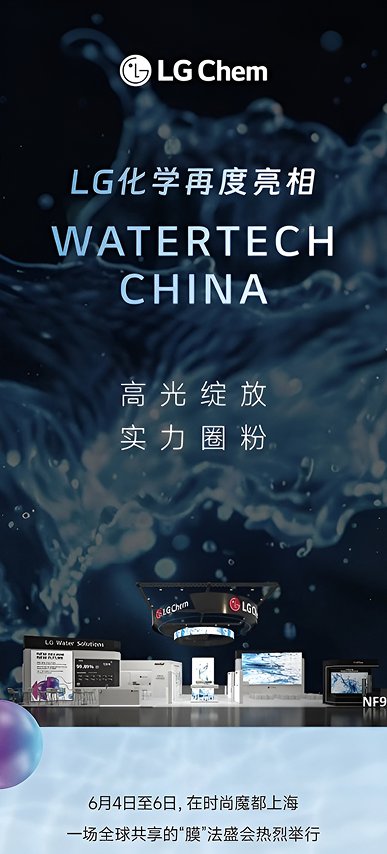
For LG Water, the mix centred on localized content and optimized paid media to build visibility and influence buying decisions in mainland China.
For HBA, WeChat played a deeper role, supporting brand authority through project storytelling and content designed for hospitality decision makers.
These examples are different because the customer journeys are different.
That is exactly the point.
How Digital Crew helps
Digital Crew can help international brands decide which Chinese platforms deserve investment before teams start building accounts and campaigns.
This can include:
The objective is not to put the brand everywhere.
It is to make each platform earn its place in the strategy.
Neither is universally better. WeChat is stronger for ongoing customer relationships, deeper content, WeCom, Mini Programs and CRM connected journeys. Xiaohongshu is stronger for lifestyle discovery, search, peer experience and product consideration. Many consumer brands need both.
They solve different problems. Douyin is particularly strong for short video discovery, large scale reach, livestreaming and commerce. WeChat is stronger for longer customer relationships, service, lead nurture, private traffic and CRM integration.
The first platform should match the biggest gap in the customer journey. Xiaohongshu or Douyin may be appropriate when discovery is the problem. WeChat may come first when trust, leads or customer relationships matter more. Ecommerce brands may need Tmall or Douyin commerce early.
WeChat and WeCom are usually the strongest starting point for B2B because they support deeper content, direct customer communication and longer sales cycles. Baidu can support high intent search and supplier discovery.
Tmall and Douyin are strong transaction environments, while Xiaohongshu can play an important role in discovery and consideration. WeChat can support membership, repeat purchases, service and customer retention.
Sometimes, but not automatically. The three platforms work well together when each has a clear role. Using all three without sufficient content, media budget or operational capacity can produce weaker results than focusing on one or two properly.