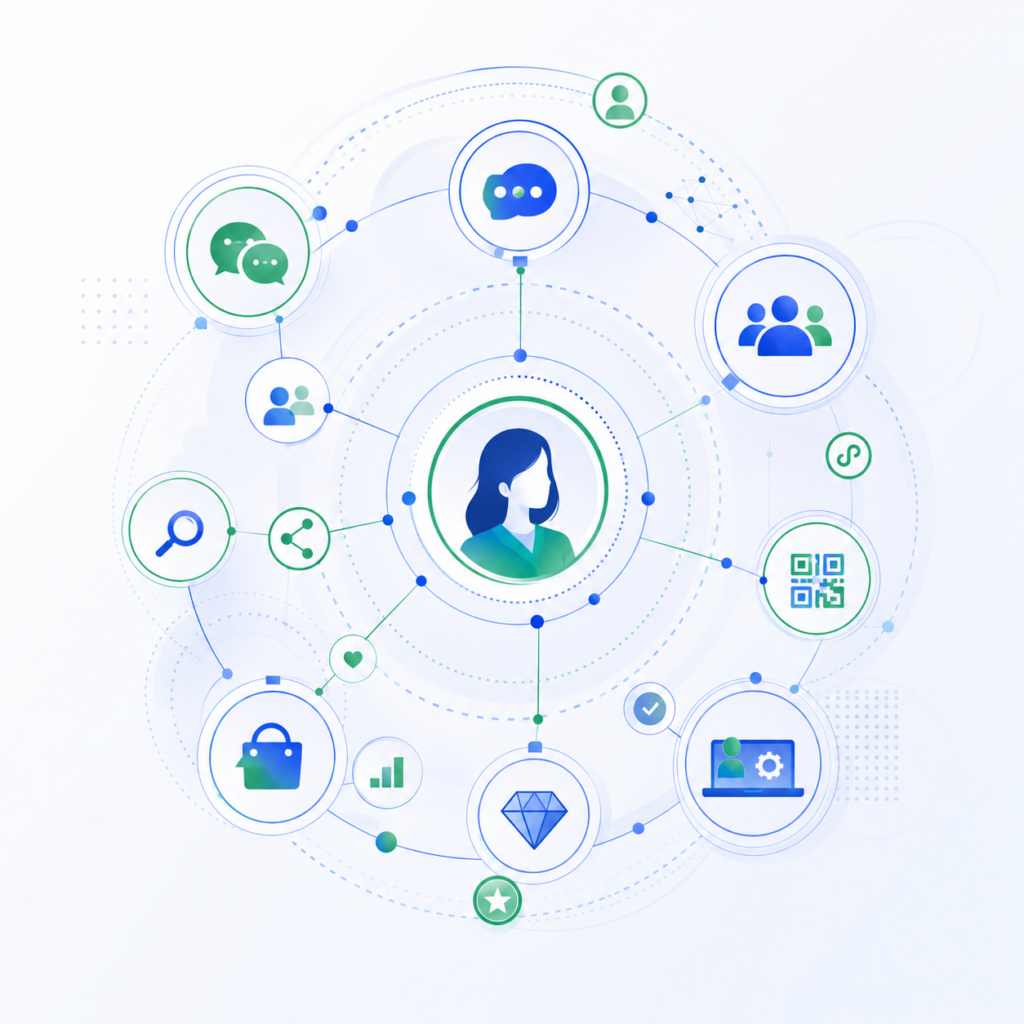
Most brands in China are very good at getting attention.
The harder part is keeping the relationship after that first interaction.
A customer might discover the brand through an ad, a KOL, a store, an event or a piece of content. But if there is no reason for them to stay connected, the brand may end up paying to reach the same person all over again later.
That is where private traffic comes in.
The idea is simple: turn an initial interaction into an ongoing customer relationship that the brand can continue to build over time.
The mistake is assuming the answer is simply: put them in a WeChat group.
You can collect thousands of contacts, build ten groups, send daily offers and still have almost no relationship with anybody in them. In fact, the more aggressively you push, the faster the audience learns to ignore you.
A quiet group full of muted notifications is not an asset.
Private traffic works when someone moves from being an anonymous visitor, viewer or buyer into a relationship the brand can continue.
That relationship might sit around an Official Account, a WeCom contact, a customer group, a membership account or a Mini Program. Usually it is a combination.
And the scale behind that system is still growing. Tencent reported 1.439 billion combined monthly active users for Weixin and WeChat at the end of Q2 2026, up from 1.411 billion a year earlier.
But scale is not really the interesting part.
The interesting part is what happens after you get someone’s attention.
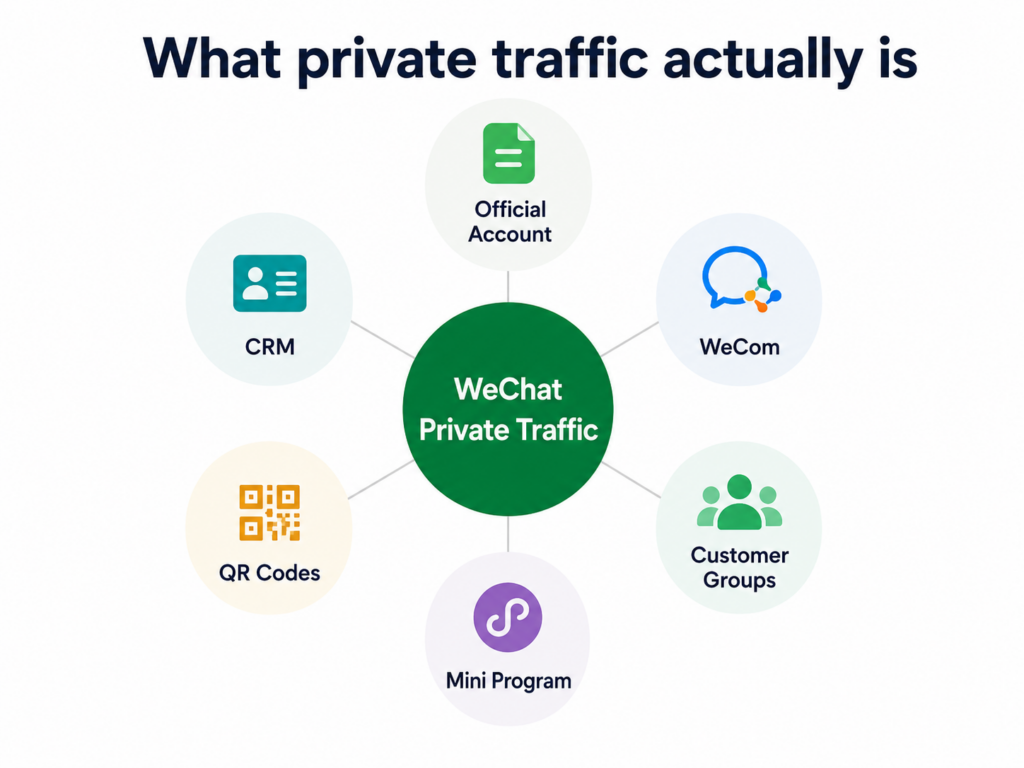
WeChat private traffic is an audience that a brand can continue communicating with inside the WeChat ecosystem without needing to buy a new advertising impression every time.
It is usually built through a combination of:
In China, the term is commonly known as 私域, often translated as private domain or private traffic.
Neither English translation is perfect.
Private traffic is sometimes described as an “owned audience,” but brands do not own WeChat itself. Tencent still controls the platform, product rules and technical environment.
What brands gain is a much more direct and persistent customer relationship.
That distinction matters.
Think about how most brands acquire customers in China.
Someone may discover the company through:
Weixin Search
Video Accounts
Xiaohongshu
Douyin
A KOL
An offline store
An exhibition
A QR code
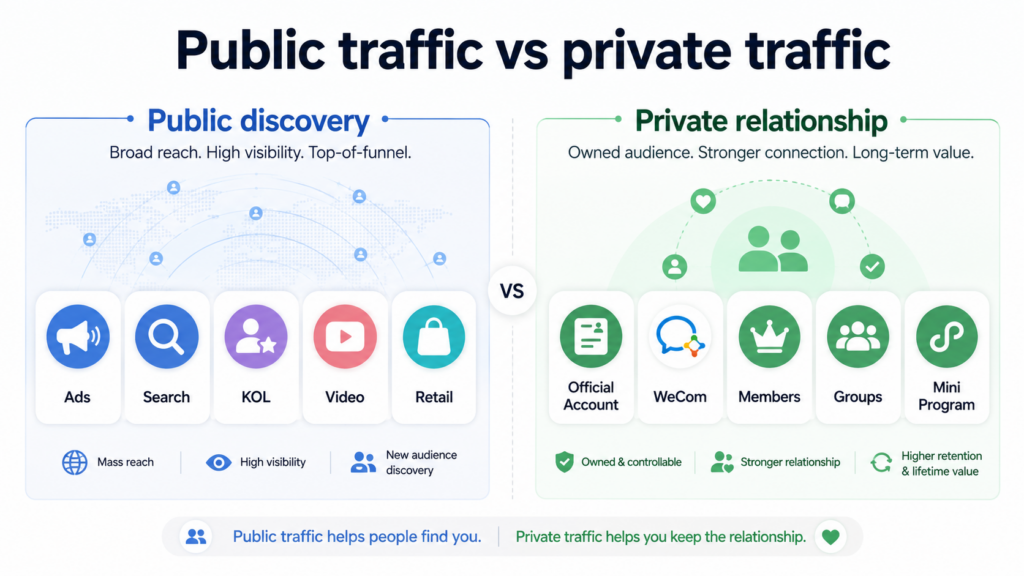
Most of those are discovery points.
The user may see the brand once and disappear.
Private traffic begins when the brand creates a reason for that person to stay connected.
For example:
WeChat ad → article → add WeCom contact → consultation
or:
Store purchase → QR code → Mini Program membership → repeat purchase
or:
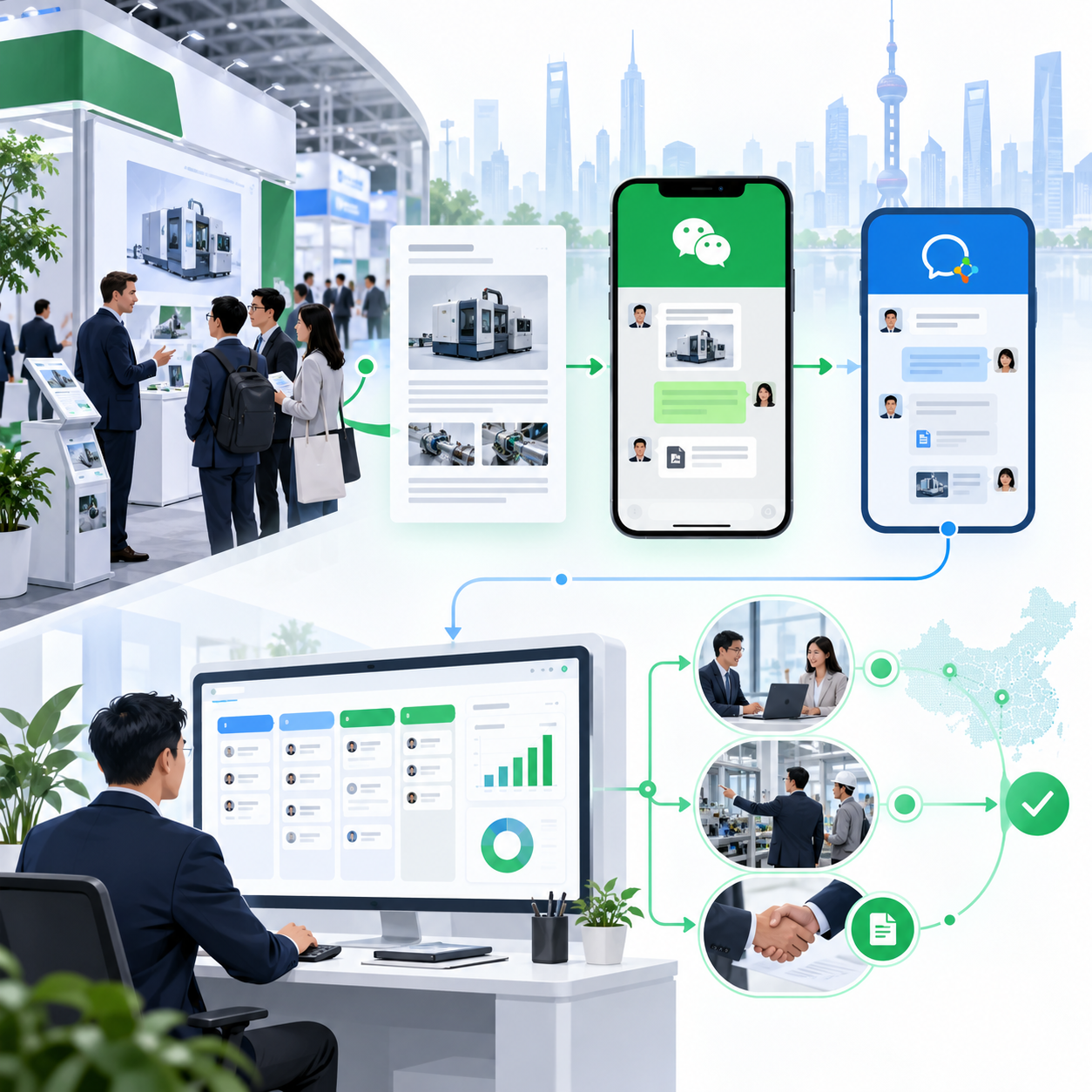
Trade show → WeCom contact → technical content → sales follow up
or:
KOL campaign → Official Account → Mini Program → membership
The handoff is the strategy.
Without it, every campaign starts again from zero.
Paid media is very good at finding people. It is less good at remembering them.
Every time a brand relies entirely on paid acquisition, it risks paying repeatedly to reach customers it has already introduced itself to.
Private traffic changes that equation.
A first campaign may still need advertising, KOLs, retail activity or other acquisition channels. But once someone becomes a follower, member, WeCom contact or known customer, the brand has more opportunities to continue the relationship.
That might mean answering a question.
Reminding someone about an event.
Sharing useful product information.
Offering customer service.
Inviting a customer to a member event.
Supporting a sales conversation.
Encouraging a repeat purchase.
None of this sounds particularly revolutionary. That is partly why it works.
Private traffic is less about finding a clever growth hack and more about remembering that the customer already exists.
For many brands, WeCom is the piece that turns private traffic from marketing into customer management.
Tencent describes WeCom as an enterprise communication platform connected with Weixin chats, Mini Programs and Weixin Pay. Employees can communicate with customers who continue using Weixin, while the customer relationship belongs to the company and can be retained if the employee leaves.
That last point is important.
If a salesperson builds relationships using a personal account, those relationships can effectively leave with the employee. WeCom creates a more structured company level relationship.
The scale is substantial.
At the launch of WeCom 5.0 in August 2025, Tencent said the platform had connected more than 14 million real enterprises and organizations, while businesses were serving more than 750 million Weixin users through WeCom each day.
That does not mean every company should immediately move every customer into WeCom.
It means WeCom gives brands a much stronger foundation when one to one follow up, sales conversations or customer service actually matter.
Private traffic is strongest when several assets work together.
An Official Account gives the brand a persistent publishing presence.
It can educate customers, answer questions, introduce products, establish credibility and point people toward deeper actions.
But an Official Account follower is not the same as a sales lead.
Following shows interest. It does not tell you how serious that interest is.
The job of the content is often to help the reader decide whether to take another step.
That might be opening a Mini Program, joining an event, contacting the company or adding a WeCom representative.
A WeCom contact creates a more direct relationship between the customer and a company representative.
This is especially useful where the purchase needs conversation.
Think:
B2B sales.
Education.
Luxury.
Property.
Travel planning.
Professional services.
High consideration products.
Customer service.
The point is not to turn the salesperson into a notification machine.
The value comes from context.
Who is this customer?
Why did they connect?
What are they interested in?
What happened in the last conversation?
What should happen next?
One hundred well managed contacts are better than a thousand poorly understood ones.
Customer groups are probably the most visible form of private traffic.
They are also the easiest to misuse.
A group works best when there is a genuine reason for people to be together.
That might be:
A university intake group.
A VIP customer community.
An event group.
A product education group.
A travel planning group.
A professional community.
A temporary campaign group.
A support community.
If the only reason the group exists is for the brand to push promotions, users eventually work that out.
Sometimes a group is not the right answer.
If the customer needs a private conversation, use one to one communication.
If they simply need useful content, an Official Account may be enough.
If they need to transact, a Mini Program may be better.
Do not build a community where there is no community to build.
Mini Programs give private traffic somewhere useful to go.
They can support:
Shopping.
Membership.
Booking.
Applications.
Product information.
Loyalty.
Customer service.
Events.
Account management.
Tencent reported in April 2026 that Mini Programs serve more than 1.1 billion monthly active users. In 2025, the ecosystem expanded across 100 countries and regions and 108 industry verticals, while cross border Mini Program transaction value grew more than 70% year on year.
This is where private traffic starts becoming more measurable. A customer does not simply receive another message. They can actually do something.
QR codes matter because the physical and digital customer journeys in China frequently overlap.
A QR code might appear:
In a store.
On packaging.
At an exhibition.
At a hotel.
On an event stand.
Inside an article.
On printed material.
At the end of a presentation.
Inside an advertising journey.
But a QR code should never be there simply because “China uses QR codes.”
Ask what someone gets after scanning it.
A useful rule is:
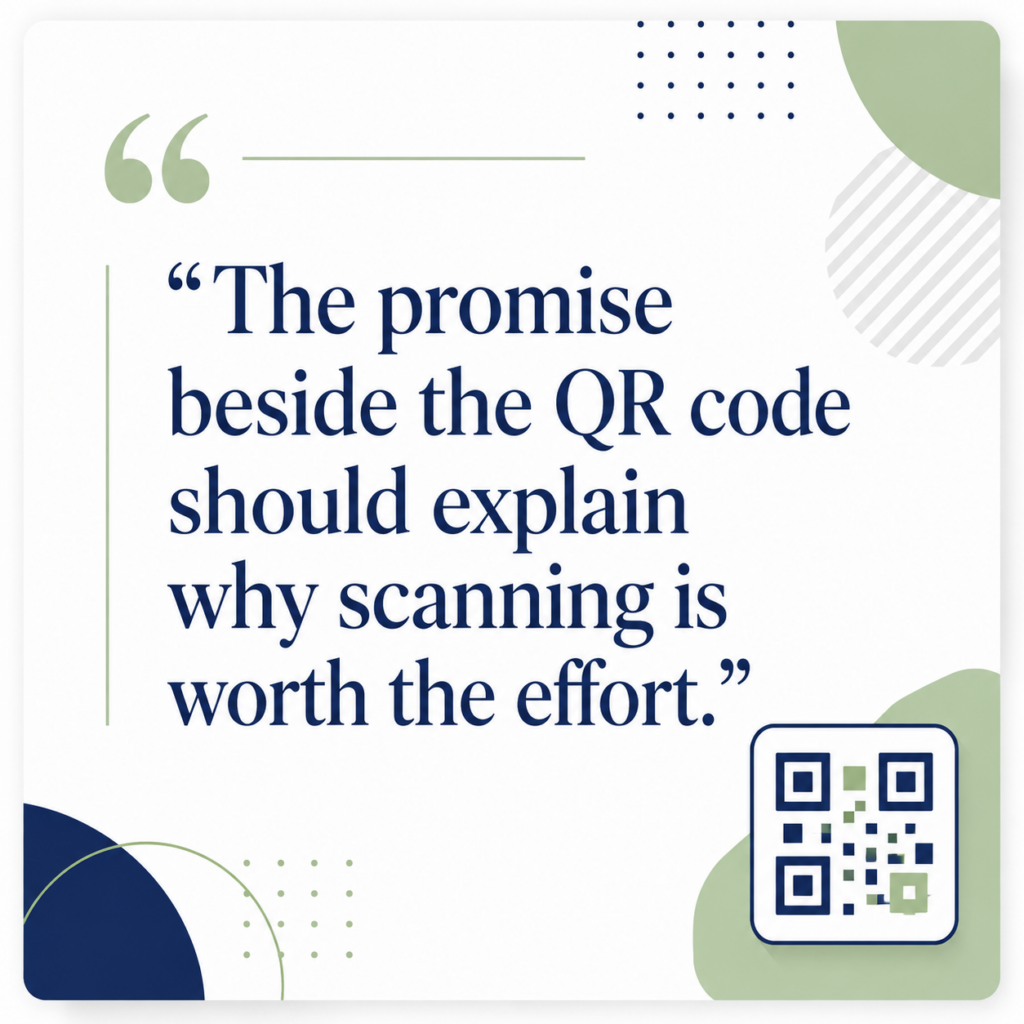
“Follow us on WeChat” is weak.
“Get the installation guide.”
“Join the webinar.”
“Access member pricing.”
“Speak with our China team.”
“Save your booking.”
Those give the scan a purpose.
Where the setup allows it, brands should also distinguish different entry sources so they can understand which locations, campaigns or events are actually producing valuable contacts.
The two ideas overlap, but they are not identical.
Community marketing uses groups and member interaction.
Private traffic is the wider system that keeps a customer connected to the brand.
A company can have a strong private traffic strategy without running large customer groups at all.
A B2B business, for example, may rely mainly on:
Official Account content → WeCom contact → CRM → salesperson
A retailer may rely more heavily on:
Store → Mini Program membership → benefits → repeat purchase
A university may use:
Webinar → WeCom → applicant questions → application
The architecture should follow the customer.
Not the latest marketing trend.
There is a predictable moment in many private traffic programs.
The audience starts growing.
Marketing gets excited.
Then everyone wants access to it.
Sales wants to send something.
The ecommerce team has an offer.
A new product launches.
There is a festival coming up.
The brand has an event.
Suddenly the “owned audience” starts receiving messages from every direction.
Tencent Marketing Cloud described exactly this problem in a 2026 case involving Chinese snack retailer Haoxianglai. By 2025 the business had more than 14,000 stores and 150 million members. Tencent noted that as membership grows, broad SMS and WeCom messaging reaches a point of diminishing returns because customers receive increasingly irrelevant information.
That problem is not unique to a company with 150 million members.
It begins much earlier.
The solution is not simply fewer messages. It is more relevant messages.
At minimum, a brand should know why someone entered the private traffic system.
Useful segmentation might include:
Signal | Example |
Source | Store, ad, KOL, exhibition, website, event |
Relationship | Prospect, customer, VIP, partner, distributor |
Interest | Product, destination, course, service |
Stage | Researching, considering, purchased, repeat customer |
Geography | City, province, market |
Behaviour | Article viewed, event attended, inquiry made, Mini Program activity |
Ownership | Salesperson, customer service team, marketing |
Not every business needs all of these.
The point is simply to stop treating every contact as the same person.
There is no universal content cadence for private traffic. And that is probably a good thing.
Someone who bought skincare may want replenishment advice.
Someone researching a university may need application deadlines.
A B2B buyer may want technical information once every few weeks.
A hotel guest may need useful information intensely for three days and then nothing for six months.
Frequency should follow the relationship.
Useful private traffic communication can include:
The word doing the most work there is relevant.
The same WeChat private traffic model should not be copied across every industry.
Industry | Useful entry point | What keeps people connected | Likely next action |
Retail and FMCG | Store, packaging, purchase, campaign | Member benefits, product launches, replenishment, service | Repeat purchase |
Luxury | Client advisor, event, store | Personal service, appointments, exclusive access | Appointment or purchase |
Travel and hospitality | Ads, booking, KOL, content | Itineraries, booking help, destination information | Booking or repeat stay |
Education | Webinar, event, Official Account | Course information, deadlines, applicant support | Consultation or application |
B2B | Exhibition, content, website, sales contact | Technical information, case studies, product advice | Sales conversation |
Professional services | Content, referral, event | Expertise, updates, consultations | Inquiry or appointment |
The differences matter.
A luxury customer may expect one to one attention.
A student may benefit from a group because hundreds of people have similar questions.
A B2B engineer probably does not want to join a “community” just to receive product brochures.
A useful private traffic system usually has five jobs.
Where does the customer first come from?
Ads, KOLs, search, retail, events, content or referrals.
What gives them a reason to remain connected?
Official Account follow, WeCom contact, membership, group or Mini Program.
What do we know about them?
Source, interest, customer stage and relevant behaviour.
What would actually be useful now?
Content, information, support, advice, benefits or conversation.
What is the appropriate next action?
Purchase, booking, inquiry, appointment, application, renewal or repeat purchase.
The system does not need to be complicated. It needs to be deliberate.
There is an appealing story about private traffic that goes something like this:
Build an owned audience and stop paying platforms for customers.
It sounds wonderful. It is also unrealistic.
Most private traffic still needs an entry point.
Someone has to discover the brand first.
That discovery may come from an advertisement, KOL, search result, event, store, distributor or piece of content.
Tencent Cloud’s current Smart Retail material describes private traffic in much the same way: brands can acquire customers through Moments, Official Accounts, Tencent Ads and Weixin Pay, then use member channels, targeted marketing, customer service and other tools for conversion and retention.
Paid and private traffic therefore do different jobs.
Paid media finds people.
Private traffic gives the brand more chances to build value after finding them.
The strongest strategy usually needs both.
This is another phrase worth retiring.
Private traffic may reduce the cost of repeatedly reaching the same audience through advertising. But operating it still costs money.
Someone needs to:
Create the content.
Answer customers.
Manage groups.
Maintain the Mini Program.
Run the CRM.
Segment the audience.
Train sales teams.
Measure results.
Handle privacy and data governance.
Remove inactive journeys.
Improve what is not working.
A badly operated private traffic system can become expensive remarkably quickly.
The goal is not free reach.
It is more valuable customer relationships.
Follower and contact growth are useful. But neither tells you whether the system is working.
A better measurement framework looks across the journey.
Layer | What to measure |
Acquisition | New contacts or members by source |
Quality | Qualified contacts, relevant segments, valid profiles |
Engagement | Replies, clicks, group participation, content activity |
Service | Response time, unresolved questions, handoff completion |
Progression | Mini Program actions, inquiries, bookings, appointments |
Conversion | Purchases, applications, leads or assisted conversions |
Retention | Repeat purchase, repeat engagement, returning members |
Efficiency | Cost per qualified relationship and value generated over time |
Not every company will be able to connect all of these. Start with what can be measured reliably. Do not invent attribution simply because the dashboard looks better with a number in every box.
A discount can persuade someone to scan a QR code. It cannot make them care about the next twenty messages.
Better approach: Decide what ongoing value the relationship offers before designing the acquisition tactic.
A prospect and a repeat customer should not receive identical communication.
Better approach: Segment by source, interest and customer stage.
Not every customer wants to talk to other customers.
Better approach: Use groups where shared conversation creates value. Use Official Accounts, Mini Programs or one to one WeCom communication elsewhere.
A large contact list can look impressive while producing almost nothing.
Better approach: Track progression, response, conversion and retention.
This is how private traffic becomes spam.
Better approach: Define communication ownership, frequency rules and approval processes.
If customer conversations live only on individual employee accounts, the company carries unnecessary risk.
Better approach: Use a structured WeCom and CRM workflow where appropriate.
The relationship may be more direct, but WeChat is still a third party platform.
Better approach: Maintain appropriate customer records, consent processes and CRM architecture rather than treating WeChat as the company’s only database.
Private traffic data is customer data. That becomes especially important for international companies connecting WeCom, Mini Programs or Chinese customer information with overseas CRM systems.
Teams should be clear about:
What information is collected.
Why it is collected.
Who can access it.
Where it is stored.
How long it is kept.
Which systems receive it.
What happens when the customer asks to leave.
Legal, privacy and information security teams should review the setup where personal data or cross border data flows are involved.
Good private traffic strategy is not just about getting closer to customers. It is also about managing that relationship responsibly.
Phase | Question | Output |
Entry point planning | Where will people come from and why will they connect? | QR, ads, KOL, retail, event and content entry paths |
Audience segmentation | Who are these people and what do they need? | Prospect, customer, VIP, partner and B2B lead segments |
Value planning | Why should they remain connected? | Content, service, benefits and community proposition |
Communication rules | Who can contact them, when and why? | Messaging and follow up framework |
CRM handoff | Who owns the relationship? | WeCom and CRM ownership |
Conversion design | What should happen next? | Mini Program, inquiry, booking, purchase or application |
Measurement | Is the relationship becoming more valuable? | Growth, engagement, inquiry, conversion and retention tracking |
Digital Crew’s wider WeChat approach already connects Official Accounts, Mini Programs, private traffic, content and paid media as parts of the same customer journey rather than separate channel activities.
For B2B companies, the logic can be even simpler. Digital Crew’s existing China B2B marketing framework already positions WeChat, Mini Programs and WeCom as connected parts of lead generation and customer management rather than stand alone social channels.
Digital Crew can help global brands design and operate a WeChat private traffic system around the actual customer journey.
This can include:
Digital Crew can help map the entry points, customer groups, WeCom workflows, Mini Program journeys and measurement needed to turn WeChat attention into a longer term customer relationship.
That is the part of private traffic that gets lost in the terminology. Customers are not assets simply because they scanned a QR code.
They can mute the group.
Ignore the article.
Delete the contact.
Stop opening the Mini Program.
Walk away from the brand.
Private traffic gives a company the opportunity to build a continuing relationship. It does not guarantee one. The brands that make it work understand the difference.
They give people a reason to connect, a reason to stay and an obvious next step when they are ready to act.
That is a much stronger strategy than building another group chat.
WeChat private traffic is a customer audience that a brand can continue communicating with inside the WeChat ecosystem without purchasing a new advertising impression every time. It can include Official Account followers, WeCom contacts, customer groups, Mini Program members and CRM connected customers.
No. Community marketing normally focuses on customer groups and member interaction. Private traffic is broader and can include one to one WeCom relationships, Official Accounts, Mini Programs, memberships, customer service and CRM processes.
Brands can bring users into private traffic through ads, content, KOL activity, stores, events, QR codes, search, websites and existing customers. The important part is giving the user a clear reason to remain connected after the first interaction.
WeCom helps employees communicate with customers using Weixin while allowing the customer relationship to remain with the company. Tencent also provides APIs that allow businesses to connect WeCom with wider systems and workflows.
Not always. Groups work best when members benefit from shared information, discussion, support or access. If the relationship is private or highly individual, one to one WeCom communication may be more appropriate.
Segment customers by interest and stage, define who is allowed to contact them, communicate when there is something relevant to say and measure negative signals as well as clicks and conversions.
Useful metrics can include qualified contact growth, response rates, Mini Program activity, inquiries, bookings, purchases, repeat purchases, customer retention and the value generated from different acquisition sources.
It can reduce the need to buy a fresh impression every time a brand wants to reach an existing customer or prospect. But private traffic still requires investment in acquisition, content, customer service, technology and operations.